Tuesday, 13 March 2012

Fiberglass 101 DVD - Highly Recommended


This DVD is just brilliant and if you are considering building a Twister then you should definitely buy it and watch it a few times.


It won't win any Oscars for acting, directing or cinematography but to hear a guru such as Sam James share his decades of experience and knowledge like this is just invaluable. It is almost totally practical too - only a bit of history and theory at the start then it is straight down to how to build parts. Then in the second half Sam covers building moulds. 2 hours of gold.


All-in-all a must have for any budding builders out there.


Buy from Tech books on the below link.


http://www.actechbooks.com/products/act193/

Wednesday, 7 March 2012

Silence Twister Hybrid

I've been thinking...


With the ever rising cost of AVGAS and the ever increasing power of batteries there will come a time when the humble piston engine will have had it's day.


We are some years away from that moment but in the meantime the most logical solution is a hybrid.


Because batteries take so long to charge up again this is the only practical solution for the foreseeable future - until there is a step change in battery technology.


Click on the pic below for a bigger view which outlines my 'mark 1' configuration.


Advantages of this set up are: 


Reduced running costs (Jet A-1 can be bought for less than half the price of AVGAS here in the UK - plus the battery charging cost is a tiny fraction per KW of power output). Also the Twister would only need approx 45kw continuous as a sustainer in the cruise - so fuel burn of the turbine could well drop to 20 LPH.


Potentially quiet operation in noise sensitive areas - battery use alone for climb out to cruise (5 mins) or approach to land. 


Greater fuel availability (Jet A-1 is much more widely available than AVGAS). 


No loss of performance with altitude (actually the turbine runs better the higher it goes).


Potentially more reliable. (In the early days this will not be the case but turbines and electric motors have extremely good track records of reliability so should be able to be made this way in this set-up).


Reduced drag. (With a very narrow cowling and only a small NACA inlet on the bottom plus the thrust from the turbine this has potential to be a more efficient setup than an air cooled piston engine).


Increased performance. (The electric motor produces phenomenal torque and 135hp for a 60 second peak, combine this with the thrust from the turbine and the climb rate would be MUCH better than standard - also the cruise speed would most likely be higher, or the same speed but with a much reduced fuel burn)


Disadvantages are: 


Initial cost of turbine and battery (both unknowns at the moment and the Bladon turbine is not in serial production yet). 


Potential noise issues with the turbine (if it cannot be made quiet). 


Weight (I believe the battery will push this over the traditional air cooled piston set up for weight).


Approval. (I can see the LAA and CAA taking a conservative approach here and not liking this one bit! So the UK may not be the place to take on such a challenge - the USA or NZ with their Experimental categories would be much better for catering with such innovative thinking)


Whilst the technology and affordability are not quite there yet it certainly points the way forward.


Maybe one day we will all have a wind turbine and solar panels on our hangers charging up our plane and be able to fly for little to no fuel cost.


As Howard Hughes would say (most likely repeatedly) "It's the way of the future".


Link to a video about the Bladon Jet here:


http://www.youtube.com/watch?v=pUf_NFOM1L4&feature=BFp&list=WL0DCC83F4EC5EF376

Saturday, 3 March 2012

Week 28 - Full and free movement

Hours to date: 275

Well the starboard aileron is now pretty much complete. Just got to add the counterweight and it's done. The factory were very kind to send me a replacement bell crank bearing free of charge - thanks Matthias!

Quite a time consuming task fitting the control surface and getting it to have the right deflections without snagging on anything. Got there in the end.

The counterweight hole had to be made quite a bit bigger but the pushrod hole and aileron root end just needed fine tuning.

After that it was back to the root rib to reinforce with carbon strips. Worked out easy this time now that the edges of the rib were smooth with a little ridge of micro on the top.

It will be time to switch back to the Port wing very soon and get that up to speed.

Fully deflected down - 90mm (wing is upside down)

Fully deflected up - 100mm

Inside wing view of the bell crank and pushrod.

Micro ridges added to the edge where the carbon reinforcing is to go.

Carbon in place - went on quite easy with the ridges.
 

Monday, 27 February 2012

SWIP Twisters in Bahrain

Looks like the SWIP duo of Pete Wells and Guy Westgate had fun in Bahrain at the International Airshow there - held close to the Formula One circuit.


I am pretty much over my cold now so 'back in the saddle' so to speak with building - did three hours yesterday and will try to do a couple of nights this week and hopefully give you an update after that. In the meantime enjoy the Twister eye candy.


Friday, 17 February 2012

Cowling design - Part 3

Well I have done absolutely nothing on the plane now for 10 days. Been struck down with a bad case of 'man flu'.


Seems to be taking ages to get rid of it so in the meantime I thought I would do a further update on the cowling design.


An interesting read was a piece about calculating total drag on a Messerschmitt 109E by Hoerner (considered by many as the God of aerodynamics).


In this article is transpired that exhaust thrust was quite a significant factor. Much more than I was expecting it to be.


The propellor produced 1,000lbs of thrust and the exhaust stacks produced 140lbs of thrust. So the exhaust was adding approx 14% of the total thrust.


Of course the 109 did not have mufflers to slow the exhaust gases down so this figure of 14% would be high compared to the UL Power set up which has a muffler.


Still, why not take advantage of that thrust rather than ejecting it at a steep downward angle and wasting its energy?


Exhaust detail. BF 109E


Another book which is well worth getting hold of is Economy with Speed by Kent Paser. No longer in print - I was able to get a copy from the States but it was not cheap (£30 I think).


Kent Paser was a NASA engineer who also built his own plane and then over the course of 20 odd years modified it. All the while recording the results of each modification so he knew absolutely what worked and what did not.


Without increasing engine size or burning more fuel he was able to increase the top speed of his plane by 64mph.


A good bit of this speed came from cleaning up the draggy parts of the airframe. 


What's relevant to us is a whole section on engine cooling. Which improved speed by 7mph. Part of it is about exhaust augmentation but mostly it is about improving the efficiency of the system.


His main points were:


· Add full pressure plenum to the top of the engine for efficient and equal pressurization of cooling air to all cylinders. The plenum also removes the problem of the cowl rising off of the traditional baffles at higher speeds.


· The smooth outflow of air at the cowl exit is just as important as a smooth inflow of air at the cowl inlets.


· Exhaust “jet-pump” helps pull air out of cowl.  Resulted in significantly cooler cylinder head and oil temperatures.  If the cooling is more than is needed then the cowl inlet size can be reduced, resulting in significant Aero-dynamic improvements.


· Reduced cowl inlet size 4 square inches at a time until CHT’s hit the bottom of the temperature range.  Initial size was 60 square inches.  Final size was 30 square inches!!  This experiment cannot be optimized until a CHT/EGT is placed on each cylinder and the under cylinder baffles must be optimized to get equal CHT’s on all cylinders.  At this point reducing the inlet size until temperatures begin to go up means that all of the air going into the intakes is being used and none is spilling out as excess, thus reducing drag.


All good. And another thing that came out of this book was possibly a better location for the oil cooler.


He copied the Mooney system of putting the oil cooler on the back of the plenum as shown below.


Mooney style oil cooler placement (pic is not of a Mooney BTW)


There may just be room to try this on the back of the UL - right hand side as viewed from the cockpit.


If this works it would certainly reduce the drag compared to the existing set up - a massive hole at the front of the cowling.


This current set up is not at all efficient - Pete has the largest available oil cooler on there and no ducting of any kind to slow the air or smooth the flow at either side of the cooler.


It does work - he has good temperatures but it most certainly is not the most efficient set up.


Radiator theory states that the opening can be 1/6th of the size of the cooler itself if set up correctly. Pete's set up is 1 to 1 - ie: the opening is the same size as the radiator face.


The problem is one of space - and trying to do this under the cowl at the front is a bit impossible - time will tell if things can be improved with this Mooney style set up.


Also if my memory serves me correctly Pete does not have a sealed plenum on top of his engine - he relies on the top part of the cowl to seal - and everything I have read says this is quite inefficient as far as cooling goes with big loses in the gaps that open up due to this system.


Last pic to close out this post is of the round inlet composite air box plenums for the UL Power engine. (which do seal completely).


Monday, 6 February 2012

Rego confirmed

Got a letter back from the CAA on Saturday - they processed the registration application very quickly. 


I can now confirm that the rego is G-FUUN.


When most people fly the Twister and are asked how was it - they ponder for a moment and then say "Gee... Fun!"


When I'm asked the question I'll be able to just smile and point at my rego!

Week 25 - Root rib and preparing parts for filling

Hours to date: 267


Spent most of the last week preparing parts for filling (car body filler works fine).


So stripping off peel ply where needed and sanding - LOTS of sanding. If you don't like sanding then the Twister is not the kit for you.


I haven't put any filler on yet - it stinks like crazy and I would like good ventilation in the garage when I do this. At the moment it is so cold here (snowed yesterday) that I cannot have good ventilation and keep the workplace at a reasonable temp to work in, so will leave this until things warm up a bit.


Also put a little more flock reinforcing on the aileron horns as they were still a bit flexible - now like a rock.


Had a go at reinforcing the wheel well hole (this comes from the factory in the same configuration for the retractable version as well as fixed gear). The carbon does not want to wrap over the sharp edges of the rib - so I will add some micro here to make the edge a more rounded profile. In the meantime I have closed up the hole a bit using carbon strips either side to make a trench which I will fill up with micro. On the fixed gear this hole only needs to be big enough to put the bell crank through - other than that it doesn't need to be there and is weakening the structure. Filling it up a bit will make it stronger without adding too much weight - the micro is a very lightweight filler.


I've also glassed the back of the rib - as Pete does. It should be plenty strong enough when done.


Got to do the same with the other wing now.


Parts prepared for filler

Aileron horn with extra flock reinforcing

Carbon strips making a trench and filling in the wheel well hole a bit

Friday, 3 February 2012

Turbine Twister in FSX - 2 new pics

They must be getting close to releasing the new version of the Twister - a couple of new shots for you in the meantime.


It would need those extra drop tanks too with the fuel burn of a turbine.


- NEWS FLASH - new version was released today (just got the email from IRIS).


Monday, 30 January 2012

G-FUUN in FSX

Been mucking about in Photoshop and got the Twister looking how I intend to paint it.

No better place to test out the paintjob than in Flight Simulator.

A short video on this link below and some screenshots below that.


Also sent off the form to the CAA for registration - hopefully I will get G-FUUN (nothing else shows up on the database under that rego). It costs 227 of our English Pounds for the privilege of an out of sequence rego in the UK.

New paint job - rego is in mirror finish chrome.

On the main runway at Duxford.

I changed the panel to be carbon - because it looks cooler :)

Overflying Duxford.

Week 24 - Rudder, Bell crank covers and Rear wing pin rib

Hours to date: 257

Not much more I can do to the rudder now until it meets up with the fuselage. All seams have been reinforced and the counterweight is in.

The bell crank covers look quite snazy now they have the allen head countersunk screws in place. Flush now with the top of the cover (and the airstream) - unlike the dome head self tappers the factory supplies.

Last job this week was working in a confined space again - flocking in the Rear wing pin rib. Not the neatest of jobs I made there but it is certainly strong enough. (if anything I over flocked!).

I've run out of Flock now so have ordered some more and will be doing the carbon reinforcing of the root rib in the meantime.

Rudder seams reinforced.

Bell Crank covers with allen head countersunk screws

Rear wing pin rib - set in place with flock

Wednesday, 25 January 2012

V-Noise

Nothing to do with Twisters but some nice aviation sounds from the one off Osprey GP5 Reno Racer - with a Chev V8 (and no mufflers) and an old favourite the V-12 Merlin - run up inside a hanger. A good way to go deaf!


http://www.youtube.com/watch?v=hGpxKY95U3s


Twister in FSX - New version coming soon

Well it seems IRIS have listened.


They are going to release a Version 2 of the Twister soon and will address the following issues.


1. Flap and Gear will be able to be assigned to joystick buttons. (my biggest gripe)


2. Integrated tailwheel version added. (2nd biggest gripe)


3. Optimised textures - giving better frame rates. (all good)


4. Night option with landing light and gauge backlighting (Kind of irrelevant for a VFR only machine in the UK - but in the USA it could be made night legal) 


Also the price will be massively reduced - I saw it on one site for 8 euros - which is a 75% reduction from the original EU price of 32 euros.


I should point out that after more extensive flight testing it flies extremely well - full spin and flick roll capability. The side slip is still not enough compared to a real aircraft - I find I am running out of rudder with only a small bank in the side slip. Yet strangely it is possible to do a knife-edge fly past - so the model does not lack rudder authority.


Also it looks like they are adding a Turbine version! 


I remember being at Oshkosh in 99 and a guy there had put a P&W-PT6 in his RV4 - his 'party trick' was being able to hover vertically - then climb away vertically - that was really impressive. I'M WRONG IT WAS NOT AN RV-4 - THE RAVEN WAS A ONE OFF ALL COMPOSITE DESIGN (NOT FLYING ANYMORE AFTER AN AIRSHOW CRASH. ON YOUTUBE HERE: http://www.youtube.com/watch?v=BJWjbpA_zIc) MORE INFO ABOUT THE RAVEN HERE: http://www.waynehandley.com/archive.html


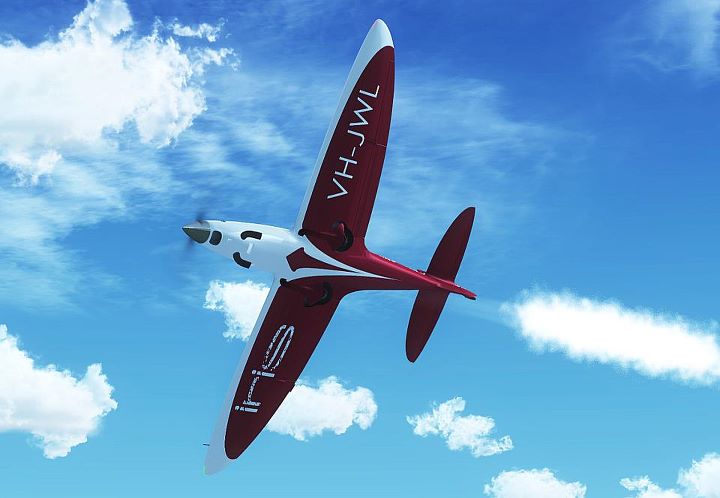
There are some more paintjobs coming in the 2nd version too - including this 'Oz Racer'.


Oz Racer

Turbine Twister!