Wednesday, 19 July 2023

A new Twister

Kit number 33 is complete and isn't she a beauty! So good it won the Best Twister award at our recent meeting.

Constructed by Eugen Schaal over 2.5 years (1,500 hrs).

Powered by the UL Power UL260iSA engine with an Airmaster electric variable pitch prop giving a 1,500 fpm rate of climb.

Eugen was lucky to build his at the Silence factory so had all the answers and help at hand - which explains the fairly quick build time for such a fine example.

I wish Eugen many happy flights.

Parked in pride of place at our recent Twister meeting.


In the factory when almost finished.


A neat idea to secure the gear leg fairing without fasteners at the front.

Ready for some more flight testing.


It look like some cowling modifications were needed to make the UL fit.


Sealed plenums rule!


Garmin screen, Trig Radio and Transponder.

Looking happy to have received the Best Twister award. 


Friday, 14 July 2023

Krishna Build Video

Check out this excellent video by Krishna of his Twister build. 

In particular the trials and tribulations with installing a Rotax 912, the first Twister to feature this powerplant.

https://youtu.be/bpNLpApoAB0


Krishna Article - Airsport Magazine


Tuesday, 7 March 2023

Wheel bearings, tailwheel axle bolt and panel upgrade

It was Annual time again in February so I finally got around to doing several jobs I'd been putting off.

I noticed when I last changed the main wheel tyres that the wheel bearings were not running smoothly. This is after 500 hrs with most of that from grass runways which get very muddy here in the UK during the winter. 

So I changed these bearings for new. I did not recognise the Italian brand of bearings that were in there from new so changed these ones for SKF which is a brand I trust. Hopefully they will last longer this time. I will make a note to check the wheel bearings every 200 hrs from now on.

The bearing part number is: 6004-2RSH SKF Sealed Ball Bearing 20mm x 42mm 12mm (BB-1853). You will need 4 in total, 2 per wheel.

Getting the old wheel bearings out was a real pain as the hub is a single piece of Ali which is not able to be split in half. There is also a spacer inside of the bearings which prevents a bearing puller being used to pull them outwards. The bearings sit on a shoulder on the inside so there was no way to push them out either.

I ended up having to dismantle one of the bearings from one side to then remove the balls and centre race, this then allowed me to remove the spacer and push out the other bearing (using a deep reach socket, a vice and the boiling water to expand the Ali hub technique). Finally I had to rework the remaining outer race of the dismantled bearing as it has a smooth concave shape which a chisel or screwdriver tip just slides off. A little Dremel work made this into a squared off shape so I was able to drive out the outer race too.

Onto the tailwheel.

This I found several months ago, the bearing had actually seized on one side.

So again these were changed for new. 

That part number is: 6300-2RSH SKF Sealed Ball Bearing 10mm x 35mm x 11mm (BB-1919). You'll need 2 of these for the tailwheel.

I also discovered that the bolt which is used as the axle for the tailwheel was slightly too short in its shank. This meant that the thread was working against the hole in the tailwheel fork rather than against the smooth shank as it should be. See the pic below.

I sourced a correct sized bolt (M10 with 120mm length) and cut it down to the required total length. This still leaves enough thread for a washer and thin Nyloc.

I'm happy to have found these faults and fixed them.

While I was working on the main wheels I decided to change the brake pads for new too. They didn't really need changing as they had only worn about 30% but as I was in there disassembling everything then it was prudent to do so.

The engine has really settled down with its tappet clearances. Cylinders, 1, 2 and 4 didn't need adjusting at all this time. Cylinder 3 needed a small tweak - but this Cylinder head is only 100 hours old as it was replaced at 400 hours due to the leaking exhaust valve.

I replaced the engine mount rubbers at the front too. You have to take the whole engine forward to get to the rear rubbers so I've left those for the time being as I don't have an engine hoist anymore.

Finally, I decided it would be a good idea to have a backup to the Dynon EFIS - in case it ever went down for any reason (even though it has a back up battery, if you were IFR and it went down you would be screwed). So at AERO Friedrichshafen last year I bought a Kanardia Horis EFIS. I got it for a special show price which made it about £300 cheaper than buying here in the UK.

To make room for it in the panel I got rid of the mag compass and moved the old 'steam' altimeter into its place.

This left the altimeter hole free for the Horis.

It's a pretty straight forward install, just connect up Pitot and Static and then power and ground. The only other two things that need sorting are the outside air temp probe, which I've located on the underside near the main gear leg and the GPS antenna which I've located in the space above the safety cell at the front.

The EFIS is fully featured and even has a dedicated G-meter screen which will come in very handy for Aeros as the one on the Dynon is not easy to read in flight as it just displays as small numbers.

Main wheel bearing hub, which is one piece and makes removing the bearings a real pain!


Destroyed wheel bearing to get it out of the hub


Old and new brake pads - not too much wear after 500 hrs

Old Tailwheel axle bolt to the left, note worn shank from seized bearing and damaged thread. New bolt cut down to same length but with correct shank length on the right.

Still room for a thin Nyloc and washer


Engine mount rubber - showing some wear and elongation of the hole


New panel with Kanardia EFIS


Features a dedicated G-Meter screen


How the panel used to look with mag compass at right


Monday, 28 November 2022

Another Twister takes to the skies

Looking beautiful in the air after a 10 year build (off an on!) by Krishna Parikh in Australia. 

This one is from an early, DG built, kit.

It is the first Twister to be powered by a Rotax 912 engine.

Empty weight 290kg. Cruises at 130 kts burning 18 litres per hour.

Swinging a huge Hercules prop - 69 inches in diameter.

This is the first Twister to fly in the Southern Hemisphere.

I wish Krishna many happy hours of flying fun.


Sunday, 27 November 2022

Six Twisters

It must be a new record? 6 Twisters in one place at once.

Photos were taken at Paderborn Haxterberg earlier this year.

I hope we can have a big dedicated Twister get together next year.


Monday, 1 August 2022

Heron Turboprop

Turboprops were, for a long time, like blue moons in light aircraft, you rarely saw one. 

Things are changing and there are more and more coming onto the market. To date this offering from Heron Turbines, in Greece, is the best fit for a Twister, if you can live with the 40 litres per hour fuel burn...

Weight is just 40kg dry, Power is 130shp - not sure what height that power is rated to but the service ceiling of the engine is 28,000 ft and finally the price. At Oshkosh they are offering a show price of just $35,000 USD (£28,700). This is around a third of the price of the Turbotech from France (see blog post from September 2021). Turbotech's price has gone up and is now around 90k Euros when I last checked.

Read more here: https://www.kitplanes.com/heron-turbine/

and here: https://www.heronengines.com/


Monday, 9 May 2022

Service

In February I flew over to West Wales to visit UL Power UK's (Metal Seagulls) new hangar and get a service and annual inspection done.

I had for some reason thought that my compressions were down and so ordered 3 new cylinder heads to replace the same as I did previously with cylinder number 3 when it's exhaust valve/seat was leaking.

As it turns out I needn't have worried as a compression test (when warm) revealed that the compressions were all good - virtually the same as they were at 200 hrs.

So I did the service myself and Jonathan Porter of UL Power UK did the annual inspection.

There were strong winds aloft as we had a series of storms during February, this made for a slow trip over but a rapid one home with a ground speed of 171 knots at 7,650ft.

Passing Talybont Reservoir - which we walked to in July 21 from our rented
canal boat nearby.


Pendine Sands. Location of the World Land Speed record in the 1920's.


At Metal Seagulls, UK UL Power agents. First things first a compression test
while the engine is still warm.


The results, which are virtually identical to that at 200 hrs. All is well.

Hooning back at great speed. 171 knots!


New battery

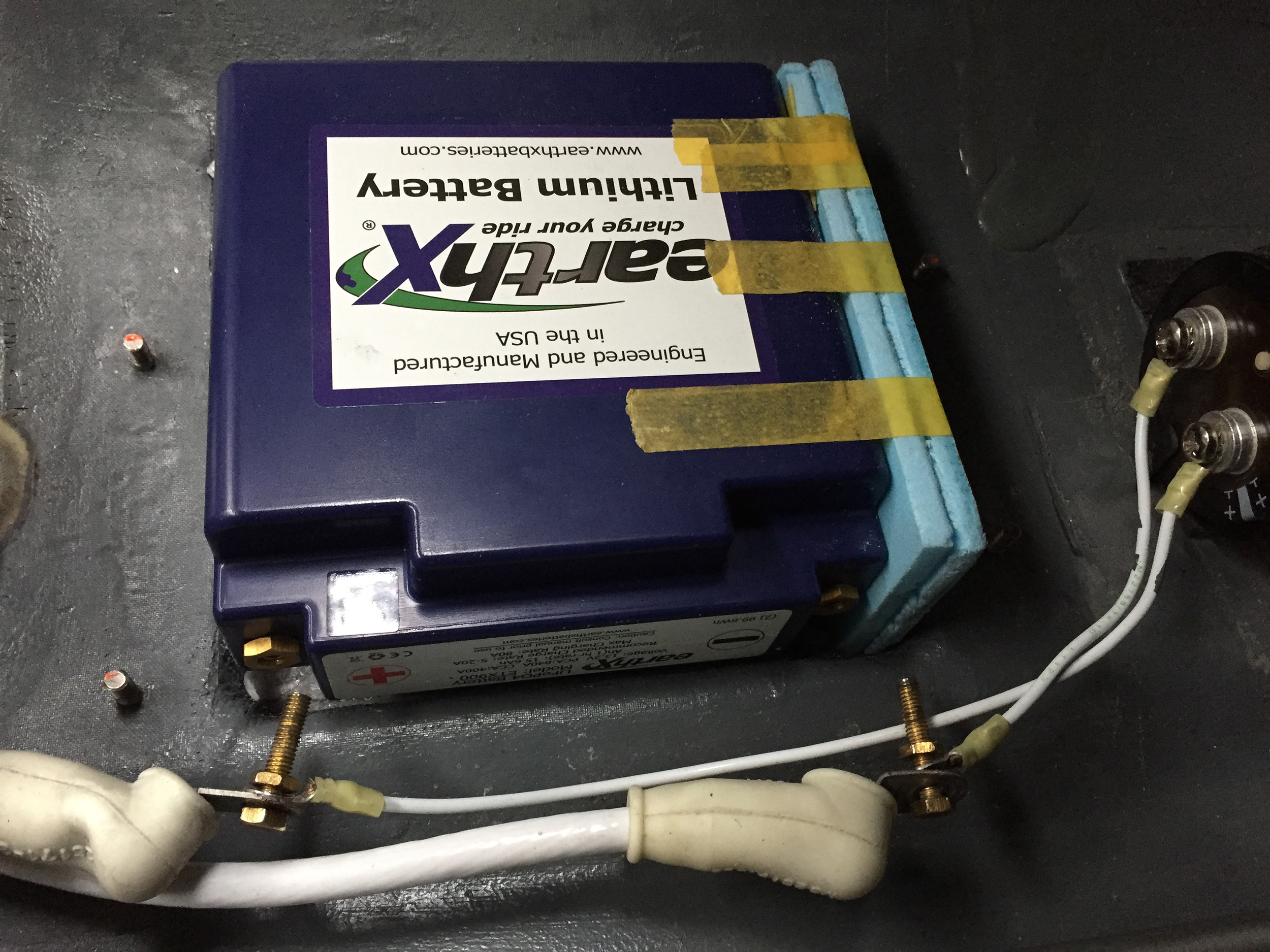
 I finally decided to take the plunge and buy a Lithium battery.

The best and safest choice is an EarthX, which is built to aviation standards and has good self protection.

The model to go for is the ETX900. It has the required amp hours in case of Alternator failure with the UL engine the battery is then the only thing providing a spark to the engine (through the coils), so it must have a decent capacity to enable you to get back on the ground in 20 mins or so before the voltage drops too low.

The price is a bit eye watering but the weight savings are great. Roughly £100 per kg saved! The old battery was 7kg and the new one is just 2.2kg.

Just as well I changed my battery as the old one was weeping. See pics below.

The old battery was the one I bought in Toronto, Canada in July of 2017 so it has served me well and was due for replacement anyway.

I noticed that the new battery holds its' charge much better when the engine is at idle - when coming back into the circuit and setting up for landing.

The dimensions were only slightly different in one axis to the old battery so I took up the space with blue foam.

Old battery - located under the baggage tray in a special recess I made.


Weeping from the old battery, just as well I changed it.


New battery in place with the blue foam as spacers so it doesn't move about
with the cover on.


Friday, 6 May 2022

Sunday, 22 August 2021

National Champion in Aerobatics

 I'm very proud to report that I won the National Aerobatics Championships (Sportsman Class) in G-FUUN.

This was especially hard considering the other aircraft I was up against. One Designs, Extras, etc.

Also it turns out that my average winning score was the highest of any competition they have held which puts another layer on the satisfaction cake.

Happy days.